
BerryTrackCount: A Video-Based Phenotyping Framework for Detection, Tracking, and Counting of Blueberry Flowers and Fruits Across Phenological Stages
Accurate phenology-specific counting of blueberry flowers and fruits is essential for yield estimation, harvest planning, and labor scheduling in commercial orchards. Unlike single-category fruit counting, blueberry video phenotyping requires the simultaneous recognition, identity association, and category-specific counting of coexisting flowers and fruits across multiple phenological stages. Existing image-level methods cannot preserve temporal identities and may repeatedly count the same target, while generic crop MOT methods are typically designed for a single category and provide limited phenological awareness. As illustrated in Figure 1, this task is further complicated by tiny targets, dense overlap and intra-stage appearance homogeneity, which can cause missed detections, identity switches, and duplicate counts. To address these coupled challenges, BerryTrackCount integrates scale-sensitive BerryDet detection, identity-preserving BerryTracker association, and Phenology-specific Trajectory-Gated Counting (PTGC) to produce stable, stage-specific counts from continuous orchard videos.
MOT Test-set Demonstration
BerryTrackCount performs detection, identity-preserving tracking, and class-specific PTGC counting on Blueberry-Test-15.
Video 1. Counting result on the blueberry MOT test set.
Real Orchard Demonstration
BerryTrackCount performs dynamic counting in a real planting-row video,
demonstrating its applicability under natural canopy conditions.
Video 2. BerryTrackCount on a real in-field blueberry video.
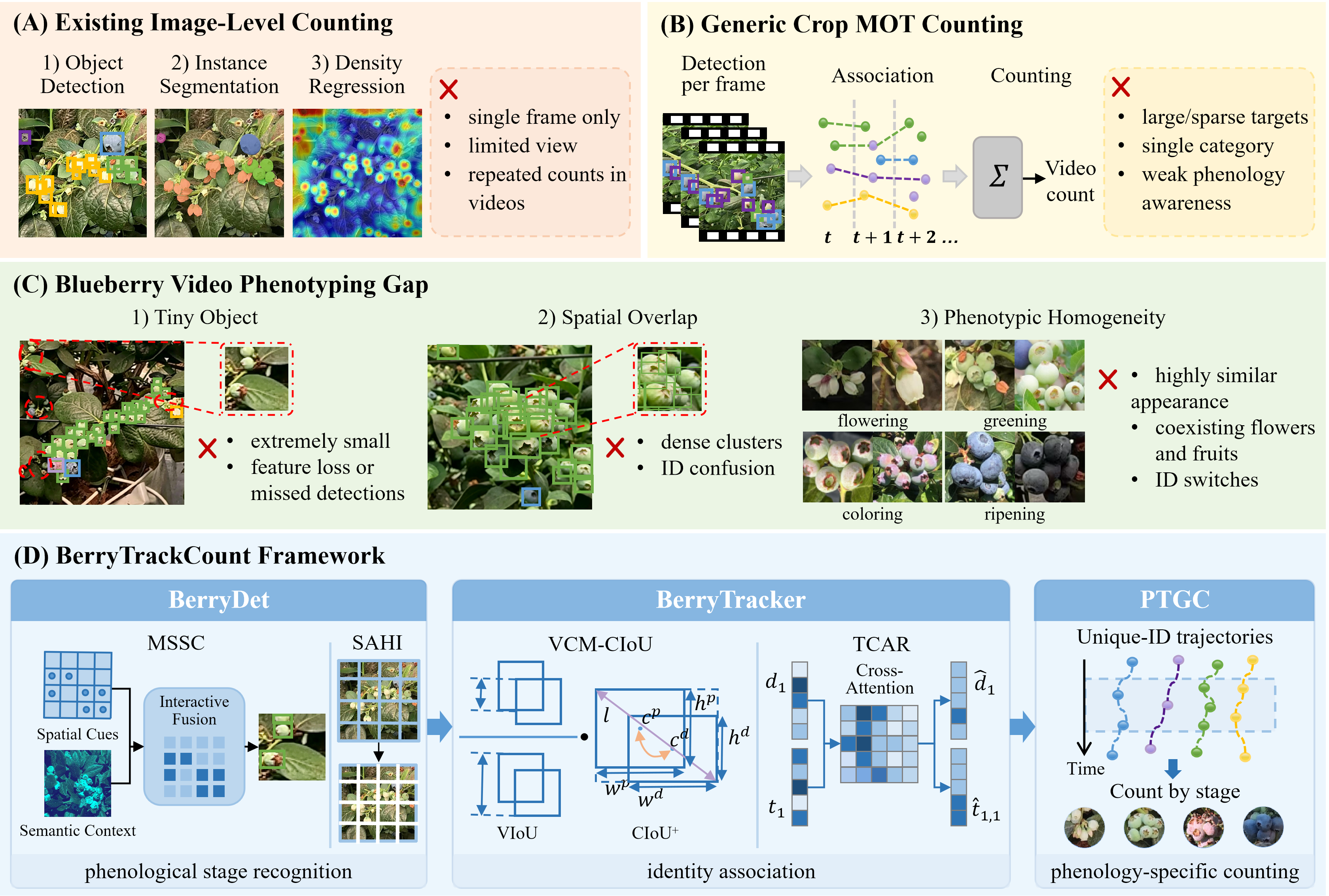
Figure 1. Motivation and overview of BerryTrackCount. (A) Image-level counting lacks temporal identity and may cause repeated counts. (B) Generic crop multi-object tracking (MOT) counting is often single-category and weakly phenology-aware. (C) Blueberry video phenotyping requires recognizing coexisting flowers and fruits under tiny-target size, dense overlap, and phenotypic homogeneity. (D) BerryTrackCount integrates BerryDet, BerryTracker, and Phenology-specific Trajectory-Gated Counting (PTGC) for stage recognition, identity association, and phenology-specific counting.
Dataset: We constructed a dedicated benchmark comprising a static detection image set and a multi-object tracking (MOT) sequence set. It covers four classes—Flower, Green, Light Purple, and Blue—corresponding to flowering, greening, coloring, and ripening stages. The detection set contains 368 high-resolution images and 66,717 annotations. The MOT set contains 40 sequences, 9,213 frames, 1,121,129 object instances, and 14,819 trajectories.
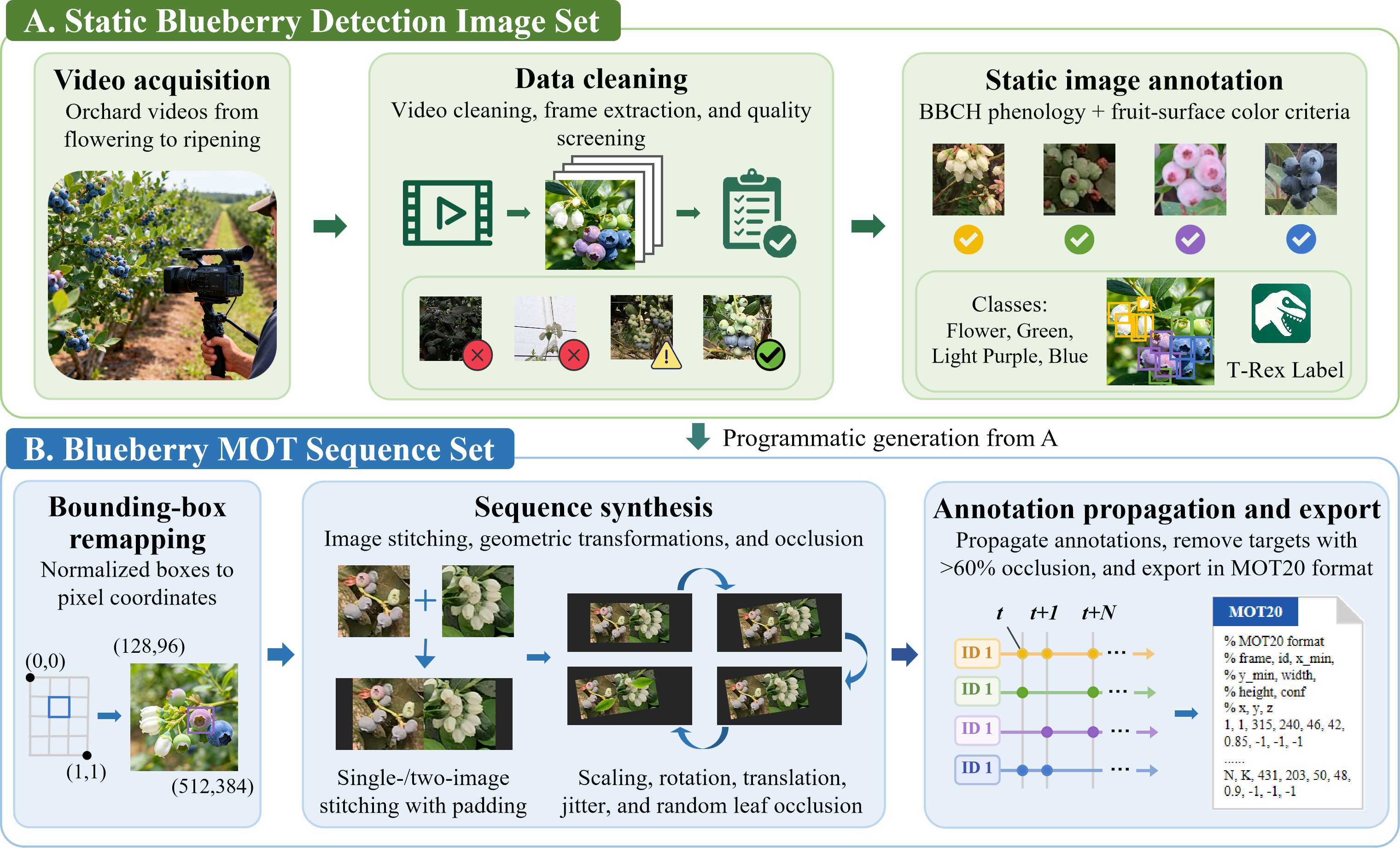
Figure 2. Construction pipeline of the phenology-aware blueberry video counting dataset. The dataset contains a static detection image set and an MOT sequence set generated from static annotations.
Overview: BerryTrackCount links scale-sensitive detection, discriminative identity association, and trajectory-gated phenological counting. Given a field video, BerryDet outputs bounding boxes, class labels, and confidence scores for each frame. BerryTracker associates detections through geometric, motion, and appearance cues to preserve identities in dense clusters. PTGC records a trajectory only when its center first enters a predefined central counting region and maintains separate ID sets for Flower, Green, Light Purple, and Blue.
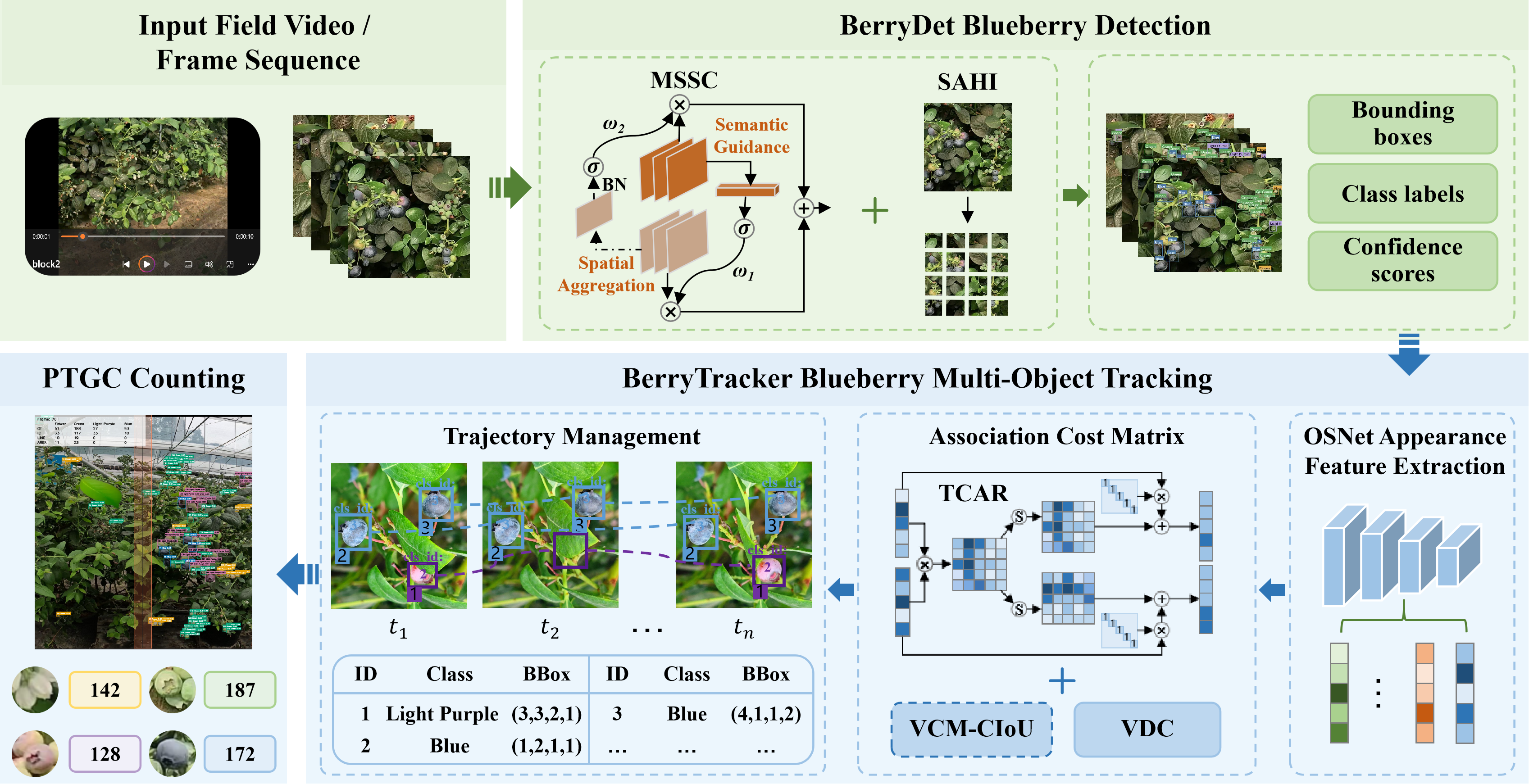
Figure 3. Overall framework of BerryTrackCount. BerryDet performs scale-sensitive detection, BerryTracker maintains target identities, and PTGC converts stable trajectories into phenology-specific counts.
Main Contributions:
- A phenology-aware blueberry video counting dataset linking class labels, temporal identities, and video-level counts.
- BerryDet, a scale-sensitive detector that combines MSSC and SAHI for small blueberry targets in high-resolution orchard imagery.
- BerryTracker, which introduces VCM-CIoU and TCAR to improve identity association under dense overlap and similar appearance.
- PTGC, which applies spatial tolerance and trajectory-level gating to obtain deduplicated class-specific counts.
Key Results: achieved 89.1% mAP@0.5. On the blueberry MOT test set, BerryTracker obtained 62.08% MOTA, 77.35% IDF1, and 2,588 identity switches while operating at 39.50 FPS. The complete BerryTrackCount framework reached 93.48% counting accuracy, a GEH statistic of 1.22, and an R2 of 0.97.
Keywords: Blueberry video counting; Multi-object tracking; Small object detection; Yield estimation; Computer vision